448 Standard exercises
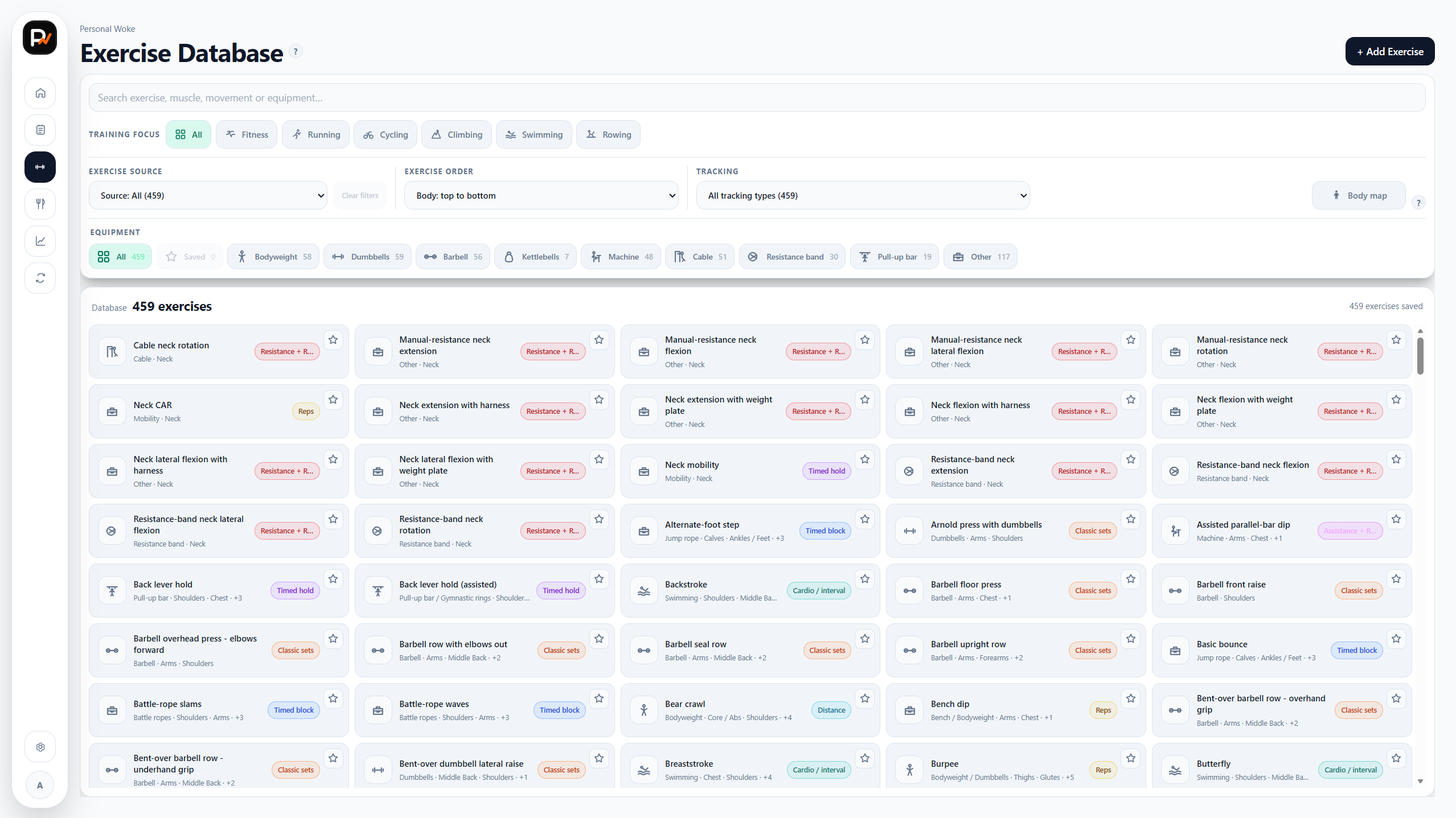
Search by name or alias, equipment, movement, muscle or body area, then narrow the list by training focus, source, exercise type, Tracking mode or the body map. Sort by relevance, anatomically from head to toe, A–Z or Z–A. Favorites and hidden exercises help keep the database practical for your own training.
A training focus changes discovery and ranking; it does not claim that an exercise belongs to only one sport. The Standard count does not include your personal exercises or personal variations.
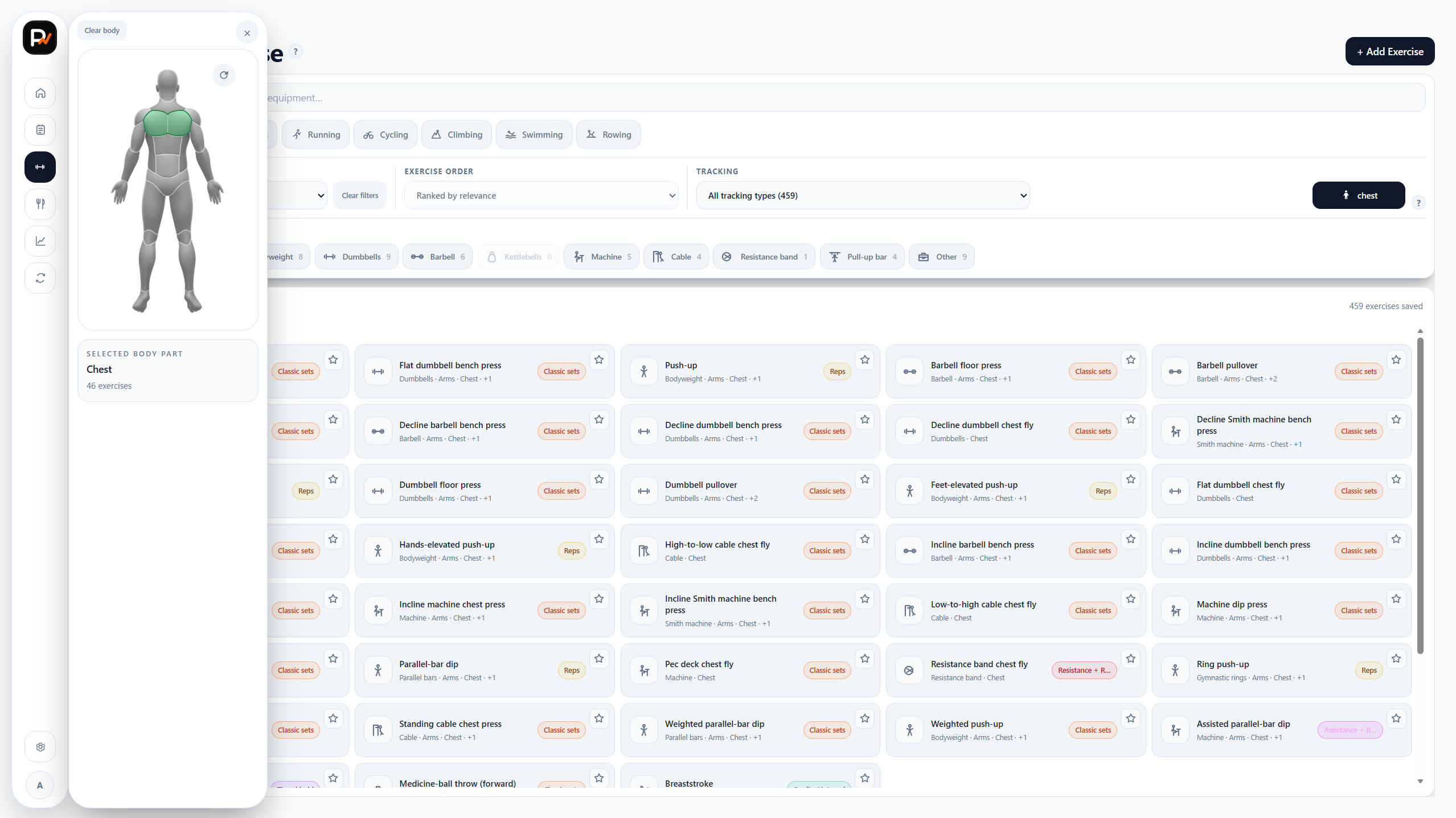
Body map: find an exercise without knowing its name
Select a body area and Personal Woke will find exercises connected to it. The detailed strength catalog is organized underneath by body area, muscle or muscle part, base exercise and execution, but you do not have to browse that hierarchy step by step. The Finder and body map use it to put exercises in the right places while keeping direct search fast.
Combine the body map with training focus, equipment or other filters when the first result is still too broad. The body map is a discovery tool, not a medical claim about which exercise is appropriate or safe for you, and not a claim that a displayed exercise isolates only that area.
Base exercise and execution
Base exercise
The movement family that keeps related strength exercises together—for example a bench press, row or lateral raise.
Execution
The actual version you choose and record—for example a flat barbell bench press or an incline dumbbell bench press.
What gets history?
The execution is the selectable exercise used in Training Days and workouts, so it is also the identity that keeps Previous and Progress history.
The structure helps Personal Woke keep anatomy, equipment and related variations organized without turning the normal exercise search into a taxonomy browser.
Eleven Tracking modes
The app calls the kind of values an exercise records its Tracking mode. Each exercise shows only the inputs that belong to that mode.
Weight + reps
Weight, repetitions and sets for ordinary loaded strength work.
Resistance + reps
Resistance in kg/lb plus repetitions and sets—for movements where the entered load represents resistance rather than an external working weight.
Assistance + reps
Assistance in kg/lb plus repetitions and sets. Less assistance means you are doing more of the movement yourself.
Reps only
Repetitions and sets when a numeric load is not being recorded.
Steps
Steps and sets for movements where the useful count is steps rather than repetitions.
Timed hold
Hold duration for each set.
Duration
Duration for each planned effort or block.
Distance
Distance and its unit for each effort.
Distance + duration
Distance and duration together; Progress can derive average pace.
Weight + duration
Weight and duration for carries, holds or other timed loaded work.
Custom
Notes for exercises that do not fit a standard numeric Tracking mode.
For compatible values, choose the unit that fits the exercise and the current entry. Personal Woke stores the physical quantity consistently so equivalent units remain comparable. For every mode, Personal Woke uses the numbers literally as you enter them—it does not double dumbbell or one-sided values.
Standard exercise, personal exercise and personal variation
Standard
An exercise from the central Personal Woke database, with its structure already defined: base, anatomy, equipment, training use, Tracking mode and discovery information.
Personal
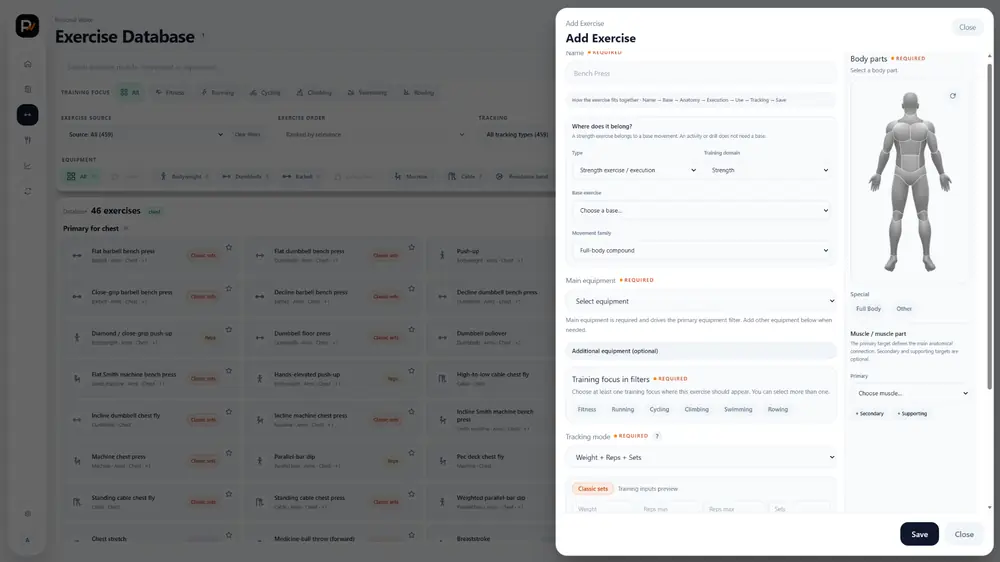
An exercise you define for yourself. For a strength exercise you choose where it belongs, its anatomy, equipment, training use and Tracking mode. If no existing base fits, you can create a private personal base for your account. Activities can remain activity-style definitions without being forced into the strength hierarchy.
Variation
Your modified version of a Standard execution. The Standard stays unchanged and the variation keeps a separate identity and history while remaining structurally connected to where it came from.
Renaming does not rewrite old workouts
When you rename a personal exercise or give an exercise your own alias, the new name is used when you choose it in the future. A completed workout keeps the name that was recorded when that workout happened.
The exercise identity and its history stay connected even though older workout snapshots show the older name.
Hide affects discovery; deletion affects future planning
Hide removes a Standard exercise from your normal finder results. Restore it whenever you want. Hiding does not remove it from an existing Training Day or completed history.
Delete is available for a personal exercise or variation. Personal Woke first shows which Training Days use it. Deletion removes those future planned uses and the personal definition, but completed workout records remain preserved as historical snapshots.
When a similar Standard exercise already exists
While creating a personal exercise, Personal Woke may point out a Standard exercise with a similar name. You can open the Standard, make a personal variation of it, or continue with a separate personal exercise.
This is a warning to prevent accidental duplicates, not a forced merge. A variation gets its own history, and choosing a separate personal exercise also creates a separate history. Personal Woke does not merge either one into the Standard later.